


- Ronny Mor
- •
- 7 Min Read
- •
- 26 minutes ago
Key Points
- Meta will deploy millions of Nvidia Blackwell and Rubin GPUs in a multiyear AI infrastructure expansion.
- The partnership extends beyond GPUs to CPUs, networking, and secure computing capabilities.
- Despite market skepticism over AI spending, hyperscalers continue aggressive capital investment to maintain competitive advantage.
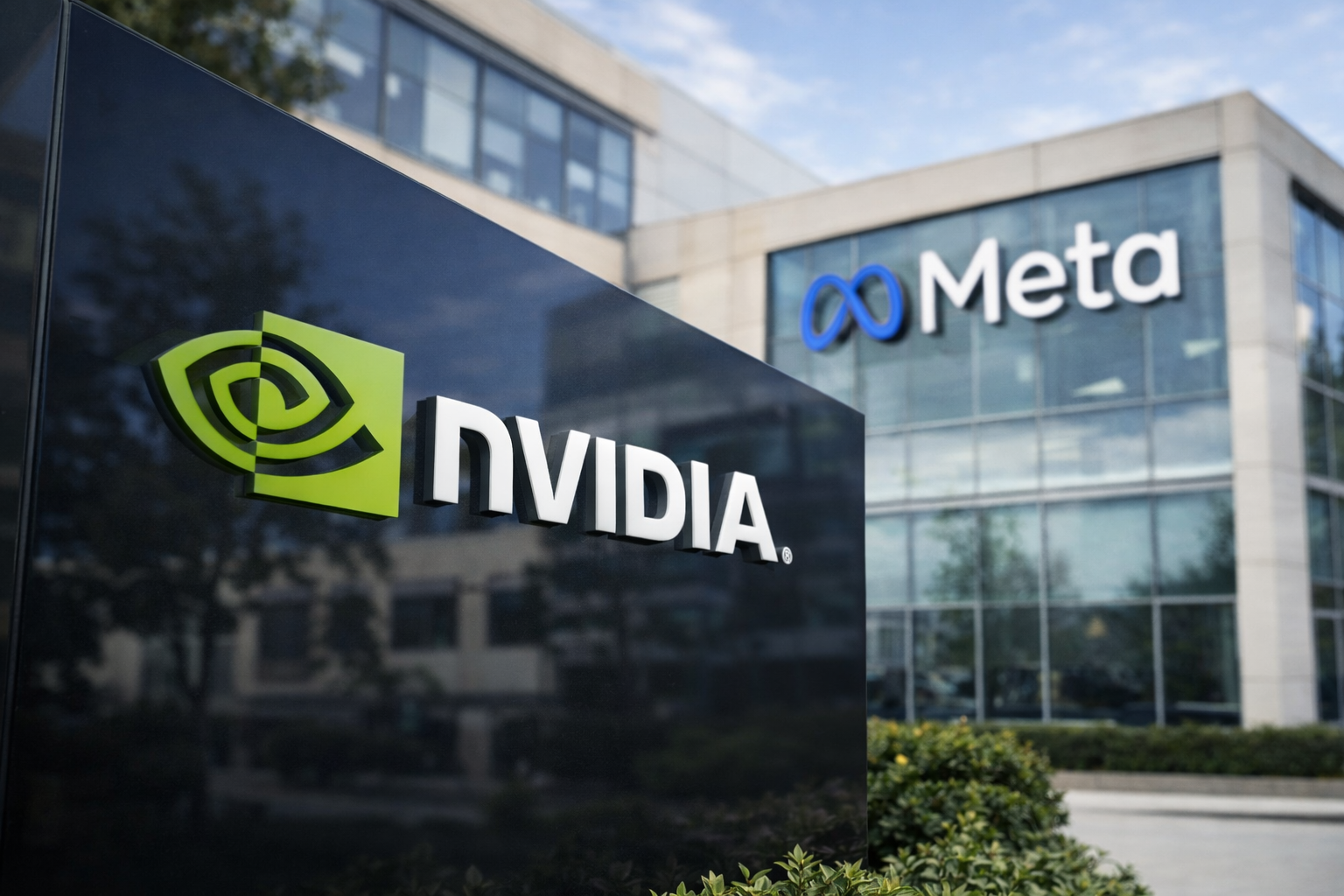
Nvidia and Meta have unveiled an expanded multiyear, multi-generational partnership that will see the social media giant deploy millions of Nvidia’s next-generation Blackwell and Rubin GPUs across its data centers. The agreement, which also includes CPUs and networking infrastructure, underscores the scale of AI capital expenditures reshaping global tech — even as investors question whether the spending boom is sustainable.
The announcement comes at a sensitive moment for AI-linked equities. After a euphoric 2025, 2026 has opened with volatility, as markets reassess whether aggressive infrastructure outlays will translate into durable returns. Against that backdrop, Meta’s commitment signals that hyperscalers are still firmly in build-out mode.
Scaling AI Infrastructure at Unprecedented Levels
Meta plans to integrate Nvidia’s GPUs into both AI model training and inference workloads, powering recommendation engines and personalization systems used by billions of users across Facebook, Instagram, and WhatsApp. Nvidia CEO Jensen Huang emphasized “deep codesign” between the companies, spanning CPUs, GPUs, networking, and software — a strategic alignment that goes beyond simple hardware procurement.
While financial terms were not disclosed, the scale implied by “millions” of GPUs suggests a multibillion-dollar commitment over several years. Meta will deploy chips both in its proprietary data centers and through Nvidia Cloud Partners such as CoreWeave and Crusoe, reinforcing a hybrid infrastructure model that blends owned capacity with third-party compute.
In parallel, Meta is rolling out large-scale Grace CPU-only servers and plans to introduce Vera CPU systems by 2027. This shift toward Nvidia-designed CPUs could disrupt Intel and AMD, long dominant in server processors. For Nvidia, it represents a vertical expansion beyond GPUs into broader data center architecture.
Investor Skepticism vs. Strategic Commitment
The expanded alliance arrives amid market unease. AI stocks have cooled since January, with Meta shares down 3.3% year to date and Nvidia off more than 1%. Microsoft has declined over 17%, reflecting broader concerns about AI-related capital expenditures potentially compressing free cash flow.
At the same time, major Nvidia customers — including Amazon, Google, and Microsoft — are developing proprietary chips such as Trainium and TPUs. Reports last year suggested Meta explored using Google’s TPU processors, highlighting hyperscalers’ desire to reduce reliance on Nvidia.
Yet analysts argue Nvidia’s GPUs maintain a structural advantage due to their flexibility. Unlike more specialized accelerators, Nvidia’s architecture supports a broad range of AI applications, from large language models to computer vision. That versatility, combined with its CUDA software ecosystem, continues to create high switching costs.
Meta’s adoption of Nvidia’s Confidential Computing technology within WhatsApp also underscores a critical dimension of the AI race: data security. As privacy regulation intensifies globally — including in Israel and across the European Union — secure processing capabilities are becoming a strategic differentiator.
The Bigger Picture: AI Spending as Competitive Necessity
The partnership reinforces a fundamental reality: hyperscalers cannot afford to fall behind in AI infrastructure. Even as markets scrutinize near-term profitability, the competitive risks of underinvestment remain high. Meta’s willingness to double down suggests executives view AI capacity not as discretionary spending but as essential infrastructure for the next digital cycle.
Looking ahead, investors will watch whether GPU demand continues at this pace, whether proprietary chips meaningfully dent Nvidia’s dominance, and how quickly AI monetization offsets capital intensity. For now, Nvidia’s ecosystem appears deeply entrenched — and Meta’s latest commitment signals that the AI buildout is far from over.
Comparison, examination, and analysis between investment houses
Leave your details, and an expert from our team will get back to you as soon as possible
* This article, in whole or in part, does not contain any promise of investment returns, nor does it constitute professional advice to make investments in any particular field.
To read more about the full disclaimer, click here
- omer bar
- •
- 7 Min Read
- •
- ago 1 hour
SKN | Is Oracle a Once-in-a-Decade Opportunity — or Just Another AI Trade at Full Valuation?
Oracle Corporation (NYSE: ORCL) has reemerged as a central player in the global AI infrastructure race, delivering a sharp
- ago 1 hour
- •
- 7 Min Read

Oracle Corporation (NYSE: ORCL) has reemerged as a central player in the global AI infrastructure race, delivering a sharp

- sagi habasov
- •
- 7 Min Read
- •
- ago 1 hour
SKN | Apple’s AI Wearable Push: Can Smart Glasses, a Pendant and Camera AirPods Redefine the Post-iPhone Era?
Apple is accelerating development of three new wearable devices — smart glasses, a camera-enabled pendant and upgraded AirPods — in
- ago 1 hour
- •
- 7 Min Read

Apple is accelerating development of three new wearable devices — smart glasses, a camera-enabled pendant and upgraded AirPods — in
- sagi habasov
- •
- 7 Min Read
- •
- ago 5 hours
SKN | Apple Accelerates AI Wearables Push – A New Growth Engine Beyond the iPhone?
Apple Inc. is intensifying efforts to integrate artificial intelligence into its wearable product lineup, marking a strategic shift as
- ago 5 hours
- •
- 7 Min Read

Apple Inc. is intensifying efforts to integrate artificial intelligence into its wearable product lineup, marking a strategic shift as

- Lior mor
- •
- 7 Min Read
- •
- ago 1 day
SKN | Can Nexperia’s $60 Million State-Backed Loan Reinforce Europe’s Semiconductor Strategy?
Dutch semiconductor manufacturer Nexperia is set to receive a $60 million loan from state-owned development financier Invest International, a move
- ago 1 day
- •
- 7 Min Read

Dutch semiconductor manufacturer Nexperia is set to receive a $60 million loan from state-owned development financier Invest International, a move

