


- Lior mor
- •
- 7 Min Read
- •
- 1 month ago
Key Points
- Institutional buying suggests rising confidence in Intel’s long-term strategy.
- Analyst caution reflects unresolved questions around valuation and profitability.
- Execution through 2026 will be critical in determining whether the rally endures.
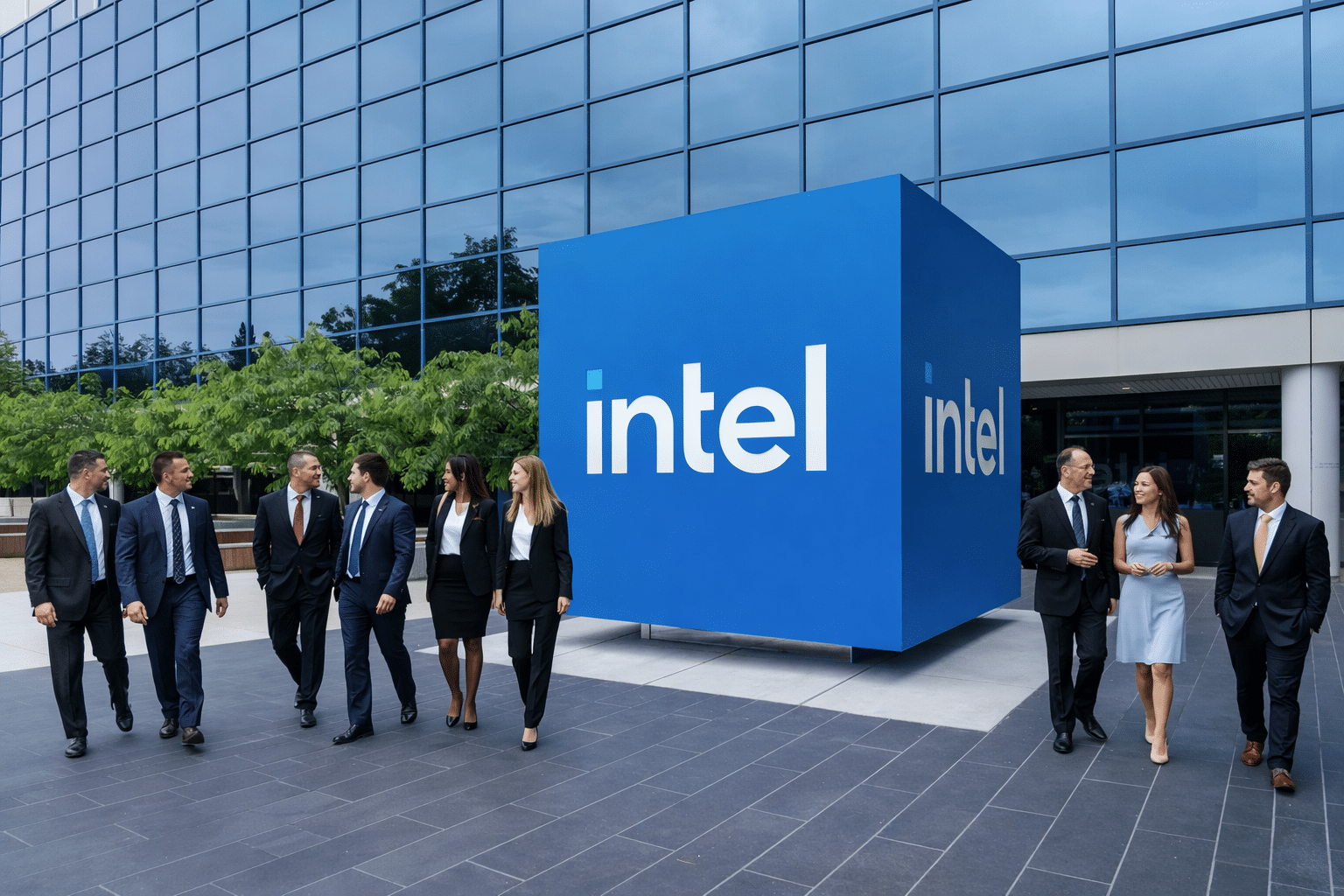
Institutional positioning in Intel Corporation is drawing renewed attention as new ownership disclosures show meaningful increases at a time when the stock is trading near its strongest levels in years. Several asset managers expanded their holdings during the most recent quarter, signaling growing confidence in Intel’s strategic direction even as debate persists over valuation and earnings visibility.
Institutional Accumulation Gains Momentum
One regional banking institution increased its Intel stake by more than 20% during the third quarter, lifting its total holdings to over 54,000 shares. While not among the largest shareholders, the move reflects a broader pattern of incremental accumulation by institutions rather than speculative buying. In aggregate, professional investors now control nearly two-thirds of Intel’s outstanding shares, underscoring the stock’s importance within diversified portfolios.
Such behavior is typical during transition phases. Institutions often build positions gradually as they reassess long-term fundamentals, particularly in capital-intensive industries like semiconductors. The steady inflows suggest that Intel is increasingly viewed as a recovery story rather than a structurally declining legacy name.
Analyst Caution Lags the Rally
Despite the sharp rally, Wall Street sentiment remains mixed. Price targets have risen in recent months, yet most ratings continue to cluster around neutral views. Analysts appear reluctant to chase the stock after a powerful run, citing uncertainty around margin sustainability, capital spending requirements, and competitive dynamics in advanced manufacturing.
This divergence between price momentum and analyst conviction highlights a classic market tension. When stocks rebound sharply from depressed levels, valuation models based on near-term earnings often struggle to justify prices, even if strategic progress is real. As a result, forecasts tend to lag shifts in investor psychology.
Momentum Reflects Strategic Repositioning
Intel shares recently pushed above $54, marking a dramatic recovery from last year’s lows and lifting the company’s market capitalization above $250 billion. The rally reflects optimism around stabilizing revenues, improving execution, and renewed focus on manufacturing leadership and external foundry services.
Recent quarterly results exceeded expectations on revenue, reinforcing the view that Intel’s downturn has bottomed. However, profitability remains thin, and traditional valuation metrics are distorted by subdued earnings, making the stock difficult to assess using conventional measures. Investors increasingly frame the story in terms of optionality: the potential payoff if Intel successfully reestablishes itself as a competitive force in advanced chips.
Risk, Psychology, and the Road Ahead
From a behavioral standpoint, Intel’s resurgence illustrates how investor narratives evolve. After years of skepticism, improving fundamentals can quickly flip sentiment, drawing in institutions that prioritize long-term positioning over short-term volatility. At the same time, the stock’s sharp ascent raises the risk of pullbacks if execution falters or expectations rise too quickly.
Looking ahead, markets will focus on earnings consistency, progress in next-generation manufacturing, and management’s ability to balance investment with returns. Whether Intel’s rally proves durable will depend less on past momentum and more on evidence that strategic bets are translating into sustainable cash flows.
Comparison, examination, and analysis between investment houses
Leave your details, and an expert from our team will get back to you as soon as possible
* This article, in whole or in part, does not contain any promise of investment returns, nor does it constitute professional advice to make investments in any particular field.
To read more about the full disclaimer, click here
- Lior mor
- •
- 7 Min Read
- •
- ago 43 seconds
SKN | Where Could Eli Lilly Stock Be in 10 Years? Growth Drivers, Risks, and the Future of the Pharma Giant
The long-term outlook for Eli Lilly and Company has become a focal point for investors as the pharmaceutical industry
- ago 43 seconds
- •
- 7 Min Read

The long-term outlook for Eli Lilly and Company has become a focal point for investors as the pharmaceutical industry

- sagi habasov
- •
- 7 Min Read
- •
- ago 1 hour
SKN | Qualcomm Claims ‘Significant Advantage’ Over Nvidia in Edge AI Race as Competition Intensifies
The competition to dominate the next phase of artificial intelligence computing is intensifying as Qualcomm asserts it holds a
- ago 1 hour
- •
- 7 Min Read

The competition to dominate the next phase of artificial intelligence computing is intensifying as Qualcomm asserts it holds a

- orshu
- •
- 8 Min Read
- •
- ago 22 hours
SKN | Financial Stocks Slide: Why Bread Financial, Perella Weinberg, Donnelley Financial, PROG, and Sallie Mae Are Trading Lower
A group of financial-sector stocks including Bread Financial (BFH), Perella Weinberg Partners (PWP), Donnelley Financial Solutions (DFIN), PROG Holdings
- ago 22 hours
- •
- 8 Min Read

A group of financial-sector stocks including Bread Financial (BFH), Perella Weinberg Partners (PWP), Donnelley Financial Solutions (DFIN), PROG Holdings
- orshu
- •
- 7 Min Read
- •
- ago 23 hours
SKN | Methode Electronics Stock Slides: What Is Driving the Sell-Off in MEI Shares Today?
Shares of Methode Electronics Inc. traded lower in recent market activity as investors digested concerns surrounding the company’s earnings
- ago 23 hours
- •
- 7 Min Read

Shares of Methode Electronics Inc. traded lower in recent market activity as investors digested concerns surrounding the company’s earnings

