


- sagi habasov
- •
- 7 Min Read
- •
- 2 months ago
Key Points
- Oracle’s AI-driven growth strategy is reshaping its financial risk profile and margin structure.
- Heavy reliance on OpenAI magnifies both upside potential and concentration risk.
- Execution over the next 12–24 months will determine whether Oracle regains market trust or faces prolonged re-rating.
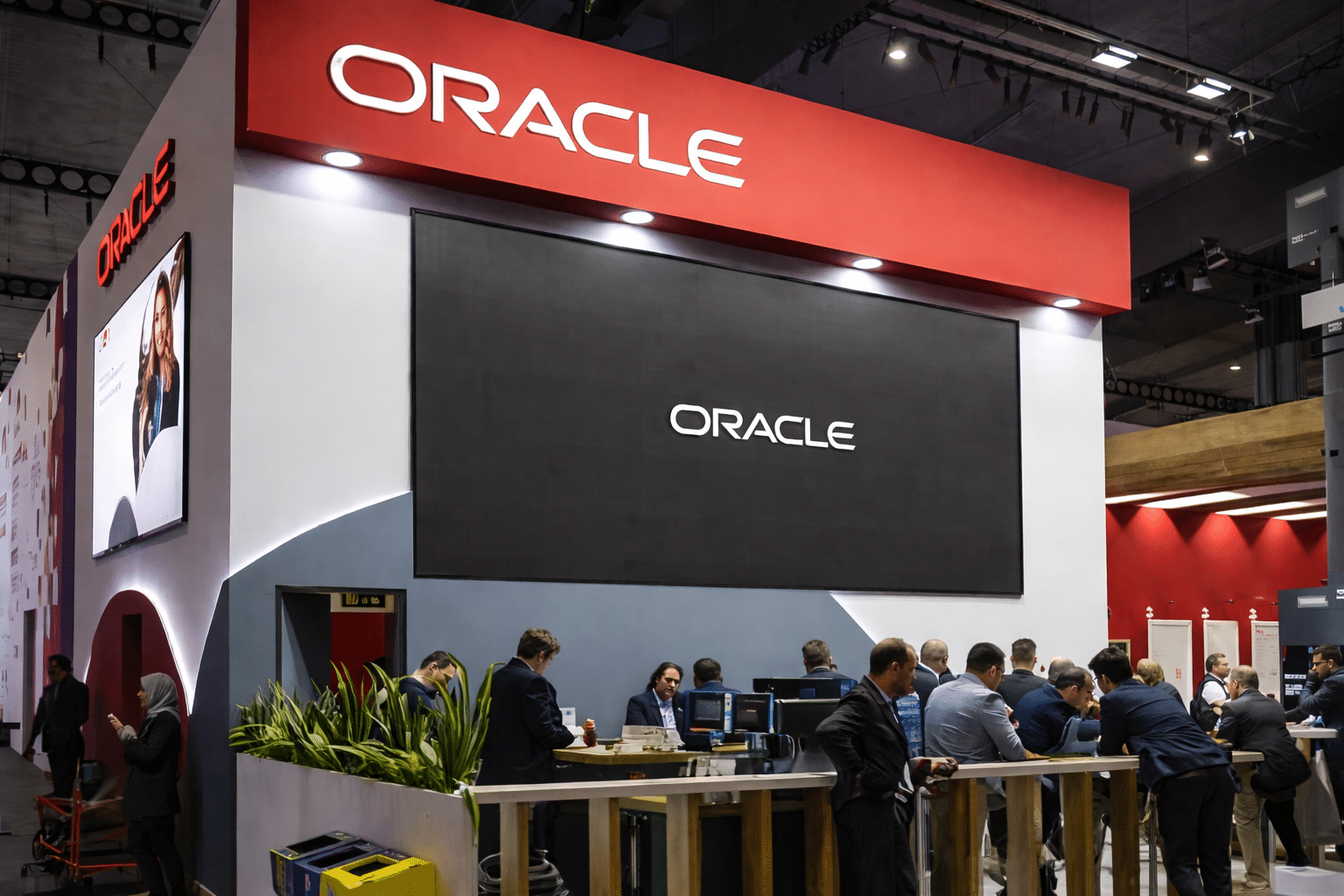
Oracle’s stock has entered rare territory. With shares down roughly 30% this quarter, the selloff is shaping up to be the company’s sharpest quarterly decline since the dot-com collapse, underscoring growing investor unease about the scale and risk of its artificial intelligence build-out. The timing is especially delicate, coming just months after the appointment of new co-CEOs Clay Magouyrk and Mike Sicilia, who inherited a strategy built on aggressive expansion rather than incremental growth.
AI Ambition Meets Balance Sheet Reality
The pressure intensified after Oracle reported weaker-than-expected revenue and free cash flow earlier this month. Management followed that disappointment with a striking forecast: $50 billion in capital expenditures for fiscal 2026, more than double last year’s spending, alongside plans for $248 billion in long-term leases to accelerate data center construction.
Much of this investment is tied to Oracle’s landmark agreement with OpenAI, which committed to spending over $300 billion on Oracle cloud infrastructure. While the deal signaled validation for Oracle as a serious AI infrastructure player, it also transformed the company’s financial profile. What was once a high-margin software business is increasingly resembling a capital-intensive utility, dependent on debt markets and long-dated contracts.
Debt, Margins, and Investor Skepticism
To fund its expansion, Oracle has already tapped credit markets aggressively, including an $18 billion bond sale in September, one of the largest in tech history. Management has pledged to maintain an investment-grade rating, yet market signals tell a more cautious story. Credit default swap prices have moved higher, reflecting concern that leverage could rise faster than cash generation.
Analysts point to a structural shift in profitability. Oracle’s gross margin stood near 77% in fiscal 2021, but consensus estimates see it falling toward 49% by the end of the decade as infrastructure spending dominates results. Forecasts also imply cumulative negative free cash flow over the next several years, a sharp contrast to the company’s historically cash-rich model.
Trust in Leadership and the Ellison Factor
Despite the turbulence, not all investors are fleeing. Long-term holders argue the stock’s collapse reflects a necessary correction after exuberance pushed shares above $340 earlier this year. Confidence, for some, rests less on near-term numbers and more on founder Larry Ellison, whose strategic instincts have repeatedly defied skeptics over five decades.
Still, reliance on a single customer looms as a key risk. OpenAI’s capital commitments are vast, but its own cash burn is substantial, raising questions about durability of demand if the AI spending cycle cools or shifts direction.
Competitive Position in a Crowded Cloud Market
Oracle’s challenge is compounded by its position relative to entrenched rivals such as Amazon, Microsoft, and Google. While Oracle boasts marquee AI customers and relies heavily on Nvidia GPUs, key software platforms like Databricks and Snowflake have yet to fully embrace Oracle’s cloud ecosystem, limiting network effects.
Looking ahead, Oracle’s valuation and investor confidence will hinge on execution. If the company delivers massive AI clusters on time and on budget, credibility could rebound sharply. If costs overrun or demand falters, the current selloff may prove only an early warning. For now, the market is signaling that Oracle’s AI pivot, once seen as a bold opportunity, has become its defining risk.
Comparison, examination, and analysis between investment houses
Leave your details, and an expert from our team will get back to you as soon as possible
* This article, in whole or in part, does not contain any promise of investment returns, nor does it constitute professional advice to make investments in any particular field.
To read more about the full disclaimer, click here
- Arik Arkadi Sluzki
- •
- 7 Min Read
- •
- ago 6 hours
SKN | Ford Stock Slides This Week: What Is Driving the Pressure on the Auto Giant?
Shares of Ford Motor Company moved lower this week as investors reassessed the outlook for the traditional automaker navigating
- ago 6 hours
- •
- 7 Min Read

Shares of Ford Motor Company moved lower this week as investors reassessed the outlook for the traditional automaker navigating

- Lior mor
- •
- 7 Min Read
- •
- ago 7 hours
SKN | Where Could Eli Lilly Stock Be in 10 Years? Growth Drivers, Risks, and the Future of the Pharma Giant
The long-term outlook for Eli Lilly and Company has become a focal point for investors as the pharmaceutical industry
- ago 7 hours
- •
- 7 Min Read
The long-term outlook for Eli Lilly and Company has become a focal point for investors as the pharmaceutical industry

- sagi habasov
- •
- 7 Min Read
- •
- ago 8 hours
SKN | Qualcomm Claims ‘Significant Advantage’ Over Nvidia in Edge AI Race as Competition Intensifies
The competition to dominate the next phase of artificial intelligence computing is intensifying as Qualcomm asserts it holds a
- ago 8 hours
- •
- 7 Min Read

The competition to dominate the next phase of artificial intelligence computing is intensifying as Qualcomm asserts it holds a

- orshu
- •
- 8 Min Read
- •
- ago 1 day
SKN | Financial Stocks Slide: Why Bread Financial, Perella Weinberg, Donnelley Financial, PROG, and Sallie Mae Are Trading Lower
A group of financial-sector stocks including Bread Financial (BFH), Perella Weinberg Partners (PWP), Donnelley Financial Solutions (DFIN), PROG Holdings
- ago 1 day
- •
- 8 Min Read

A group of financial-sector stocks including Bread Financial (BFH), Perella Weinberg Partners (PWP), Donnelley Financial Solutions (DFIN), PROG Holdings

